
Musculoskeletal Injuries Found to be Responsible for the Majority of Workers’ Compensation Costs
The Challenge
A university sought to reduce the frequency and severity of musculoskeletal (MSD) injuries among employees in its Grounds Maintenance, Operations, and Custodial Services departments. These employees routinely perform physically demanding work involving lifting, carrying, pushing, pulling, digging, and material handling—activities that place them at increased risk for sprain and strain injuries.
An analysis of the university’s 2023 workers’ compensation data revealed that 75% of total workers’ compensation claim costs were attributable to musculoskeletal (ergonomic) injuries. This represented the organization’s single greatest opportunity to reduce workers’ compensation expenses, recover lost productivity, and improve operational performance.
Strategic Response
To address its largest workers’ compensation cost driver, the university partnered with Future Industrial Technologies (FIT) to implement the Backsafe® Injury Prevention Program across its Grounds Maintenance and Operations, Trades, and Custodial departments.
Over a three-year period (2023–2025), FIT’s Certified Injury Prevention Specialists delivered hands-on, job-specific 2-hour workshops focused on safer body mechanics, stretching and practical injury prevention techniques that employees could immediately apply during their daily work activities.
Measurable Results
Following implementation of the Backsafe® program, workers’ compensation data supplied by the agency’s third-party claims administrator was analyzed to evaluate changes in musculoskeletal injury trends.
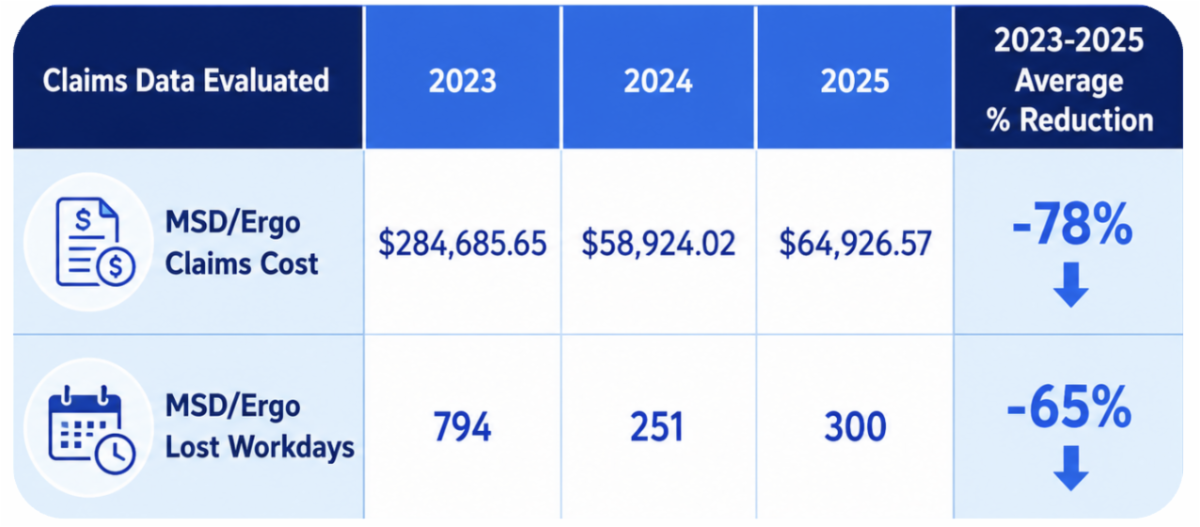
The results demonstrated substantial reductions in the injuries responsible for the majority of the university’s workers’ compensation costs.
*Results described in this case study are based on workers’ compensation data provided by the organization’s third-party claims administrator. Individual results may vary depending on workforce, implementation, and organizational factors.
Measured Outcomes
- 65% average reduction in musculoskeletal/ergonomic injury claims
- 78% average reduction in musculoskeletal injury claim costs
- 65% average reduction in musculoskeletal injury lost workdays
Business Impact
By targeting the injuries responsible for 75% of workers’ compensation claim costs, the university realized significant operational and financial improvements.
Over the 3-year period, the organization realized:
- Approximately $223,000 in average annual reductions in musculoskeletal workers’ compensation claim costs.
- An average of 519 productive workdays recovered each year through reduced injury-related lost time.
- Significant decreases in both injury frequency and injury severity.
- Reduced operational disruption caused by employee injuries and lost-time claims.
Why It Worked
Traditional injury prevention programs often emphasize rules and compliance; however, they miss the key difference maker between a successful initiative and a failed one.
Backsafe® is built on a training philosophy that goes beyond only teaching proper lifting techniques. While many injury prevention programs focus solely on the science behind musculoskeletal injuries, Backsafe also addresses the critical element that drives lasting results. Backsafe training connects the science of how injuries occur to attendees personally, resulting in elusive “Ah-ha!” moments. These realizations are the catalyst that employees need to make the decision to use the Backsafe principles at work and in their lives — the holy grail of any employee training initiative.
Conclusion
This case study demonstrates that organizations can achieve meaningful reductions in workers’ compensation costs by targeting the injuries that drive the greatest financial impact.
By targeting musculoskeletal injuries, frequently the most costly workplace injuries, organizations can experience significant, if not windfall, savings on workers’ comp costs and significant increase in employee output due to recovered productive workdays.
What Would a Reduction in Injuries and Injury Severity Mean for Your Organization?
Contact us today to discover how FIT can help reduce workplace injuries and enhance productivity through our Backsafe® and Sittingsafe® workshops.
Schedule a discovery call today to discuss your organization’s challenges and see whether a customized Backsafe program may be a fit for your team.

Dennis Downing
Future Industrial Technologies, Inc.
dennis@backsafe.com
1-800-775-2225
Prevent Tomorrow’s Injuries Today™!
Recent Comments